


Summary
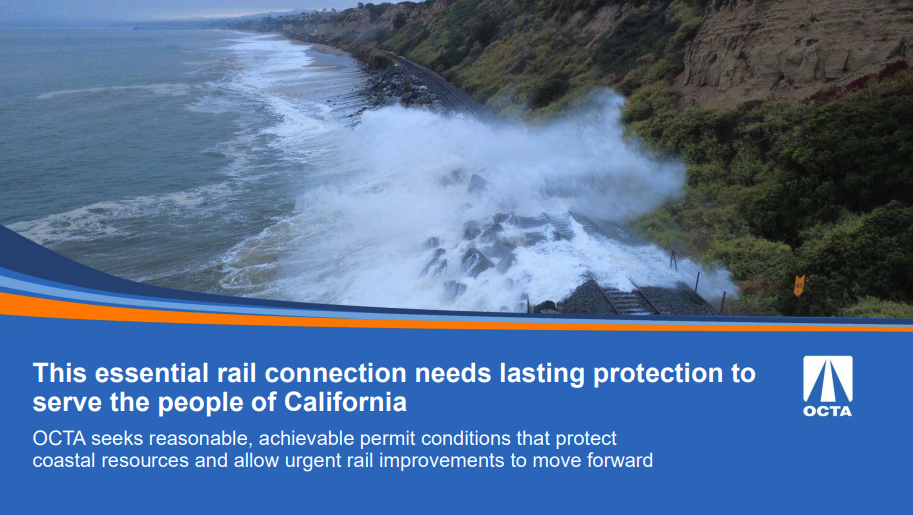
On November 5, after several hours of deliberation, the Coastal Commission gave the Orange County Transportation Authority (OCTA) a 10-year permit to protect its railroad along San Clemente’s beaches. OCTA gets to retain over 46,000 tons of emergency rock placed since 2021, add significantly more rock within the existing footprint, and build a 1,200-foot seawall across a popular stretch of San Clemente State Beach. All told, a mile and a half of beach will become a pile of rocks, a wall of concrete, or both.
As mitigation, OCTA committed to placing 690,000 cubic yards of sand in front of its armoring. It’s uncertain whether, or for how long, that sand will stay.
ActCoastal partners, local residents, and tribal representatives presented a unified front, asking the Commission to:
- Require OCTA to maintain a walkable beach in front of its armoring for the full permit term
- Hold OCTA’s rock to limits the Commission already set, including at Cyprus Shores, where emergency rock spilled 20 feet beyond OCTA’s right-of-way
- Require the long-term rail study to name a preferred plan that any future permit must follow
In response to an addendum granting OCTA more freedom to add additional rock, ActCoastal members also urged for a cap on how much new rock OCTA can add before returning to the Commission.
Commissioner Lowenberg was the first to side with the public, likening OCTA’s ever-expanding rock placements to the definition of insanity: doing the same thing over and over and expecting a different result. Commissioners O’Malley and Hart agreed. Hart was especially concerned about the impacts to San Clemente State Beach, where OCTA’s seawall will be built.

Thus began a long back-and-forth between Commissioners, Commission staff, and OCTA over what it would take to maintain a 50-foot beach in front of the armoring for the full 10-year permit. Commission staff pushed back on the requirement, citing a lack of data around what it would take to maintain a minimum beach width. Commissioners Lopez and Smith were uncomfortable with committing a public agency to do something without knowing the cost. Director Huckelbridge ultimately suggested a five-year check-in on OCTA’s single sand placement instead. The Commissioners accepted the compromise, and the amended permit passed unanimously.
OCTA will now come back before the Commission in five years to assess how the sand replenishment performs. Depending on the results, the Commission will consider requiring OCTA to maintain a passable beach in front of its armoring. That’s less than ActCoastal and the community asked for, but it’s not nothing. Still, the mitigation package was too little, too late to earn a Pro-Coast vote without substantially stronger conditions. This was an Anti-Coast vote.
The video below features compelling testimony from Nathan K. Banda, Tribal Chairman of the Juaneño Band of Mission Indians, Acjachemen Nation. It also features Surfrider's group presentation, along with some of the initial deliberation between Commissioners and Commission staff.
Why You Should Care
This emergency was decades in the making. Floods and bluff failures have disrupted this rail line since the 1930s. San Clemente secured funding to study relocating the tracks in 1972, but the study was never done. In 2003, the railroad promised the Commission a limit on rock, a maintenance plan, and sand. Commission staff found no evidence those promises were kept. By failing to plan, OCTA turned a foreseeable hazard into a standing emergency of its own making.
This permit also exposes a back door in the Coastal Act. Emergency permits are supposed to be temporary. OCTA used emergency permitting to dump rocks on the beach for five years, much of it dumped haphazardly and now strewn across the public beach. And it gets to keep all of it. By the time the emergency rock received Coastal Act review, the beach at Cyprus Shores was already gone. Staff valued the beach and sand lost to this armoring at $107 million, and acknowledged that the mitigation package could not close a $73 million gap.
Meanwhile, OCTA has received $305 million in state and federal grants to hold the line for 30 years, despite being unable to reliably keep trains running. The line has been fully closed for 12 months since 2021. Hundreds of millions in taxpayer dollars to fight a losing battle against the ocean, one that is destroying an entire city’s beaches in the process. The rail segment has become a boondoggle, but the powers that be haven’t admitted it yet.
While this permit is settled for the next 10 years, the fight for San Clemente’s beaches continues. Ultimately, the ocean will decide how long this rail segment continues operations. Armoring and sand only buy time. ActCoastal will keep pushing for relocation to be pursued with the urgency this crisis demands, and we’ll keep standing up for San Clemente’s beaches. The public must keep speaking up.
Outcome
Pro-Coast Vote
Anti-Coast Vote
Organizations in Support
Organizations Opposed
Surfrider, Save Our Beaches San Clemente, OC Coastkeeper, California Coastal Protection Network, Bring Back Our Beaches, Mission Band of Juaneño Indians Acjachemen Nation, CA State Parks Orange County
Decision Type
Coastal Development Permit
Staff Recommendation
Approve With Conditions