


Meeting Overview
The Coastal Commission met in Imperial Beach from December 10-12, 2025. A packed Wednesday agenda included updates on the transboundary pollution crisis in the Tijuana River Valley, sea lions at La Jolla Cove, and the Commission's developing guidance on nature-based adaptation strategies. Additionally, the Commission adopted its 2026-2030 Strategic Plan with support from several coastal advocates, including Surfrider and Heal the Bay. The Commission heard three appeals of new home developments along Beach Road in Dana Point, approving all on de novo with stronger coastal resource and public access protections than previously approved locally by the City (see pro-coast vote). Commission staff also reported their issuance of a fourth emergency CDP for Orange County Transportation Authority to place boulders on the beach between San Clemente and San Onofre State Beaches, an issue of grave concern for Surfrider and local beachgoers and surfers.
Diablo Canyon Nuclear Power Plant dominated Thursday's agenda, continued from last month after Pacific Gas & Electric (PG&E) declined to accept improved mitigation measures put forth in a letter to the Commission by Senator John Laird and endorsed by Commissioners. Commission staff negotiated major improvements to PG&E's mitigation package, leading to a 9-3 vote to approve a 5-year CDP for continued plant operations along with a 20-year consistency certification (see vote chart for more info).
Also on Friday, the Commission approved an after-the-fact CDP for unpermitted patio development by Patio 66, a concessionaire on the Santa Monica Pier. The after-the-fact permit resolved the enforcement matter, with Patio 66 accepting multilingual public access signage and a marine debris reduction plan (see vote chart to dive in). Lastly, Commissioners approved a much-needed 100% affordable housing project in downtown Santa Monica in a space that previously housed a public parking structure, resulting in the final pro-coast vote of the year.
The December meeting marked longtime Executive Assistant Vanessa Miller's last before retirement. Emotions ran high as Commission staff, Commissioners, and members of the public bid her farewell and shared fond memories from her 32 years at the Commission. Act Coastal sincerely thanks Miller for her three decades of dedicated service to the California coast, and wishes her well in retirement.
Read on to learn more about each of the aforementioned items.
Issues voted on at this meeting:
The Commission approved a coastal development permit for demolition of an existing single-family residence and construction of a new home on caissons at 35665 Beach Road in Dana Point, but imposed significant conditions to protect coastal resources over the project's 75-year lifespan due to its beachfront siting on a rapidly eroding shoreline.
The Commission approved an after-the-fact CDP for Patio 66, a small bar and grill with 2,836 sq. ft. of public seating on the Santa Monica Pier. ActCoastal commends the Commission for imposing robust conditions to protect public access and reduce ocean pollution from single-use plastics.
The Commission unanimously approved the agency's next 5-year Strategic Plan with support from coastal advocates including ActCoastal members Surfrider and Salted Roots.
The Commission unanimously approved a 100% affordable housing project on 4th Street in downtown Santa Monica, replacing a previous city-owned parking structure that was underutilized. The Commission approved removal of the parking structure in a previous CDP, knowing full well that the City’s intent was to replace it with much-needed coastal zone affordable housing.
The Commission approved PG&E's coastal development permit and federal consistency determination for extended operations of Diablo Canyon Nuclear Power Plant through October 2030, conditioned on a significantly enhanced mitigation package. However, the mitigation for California's "deadliest predator" still fell short of what ActCoastal called for, resulting in an Anti-Coast vote.
Other Discussions
Draft Nature-Based Adaptation Guidance
Commission staff provided an informational update on draft guidance meant to guide local governments and other applicants through consideration and planning for nature-based adaptation strategies (NBAS) in conjunction with overall sea level rise planning. Surfrider weighed in during public comment to reiterate suggestions from their comment letter: that sand replenishment alone should not be considered nature-based adaptation, and that larger-scale sand projects should be conditioned to include actual nature-based adaptation, like vegetated dune restoration, whenever feasible. Doing so would add not only ecological benefits, but also natural sand retention.
Significant debate continues over what constitutes nature-based adaptation, with certain coastal cities and local advocacy groups arguing that hard infrastructure proposals like artificial reefs and headlands are “nature-based” since they seek to replicate features that exist naturally elsewhere. Surfrider and many coastal advocates disagree with this assertion - in no circumstances should hard infrastructure projects which disrupt rather than restore the “natural” setting of a particular coastal environment be considered NBAS.
Informational Update on the transboundary crisis in the Tijuana River and Tijuana River Valley
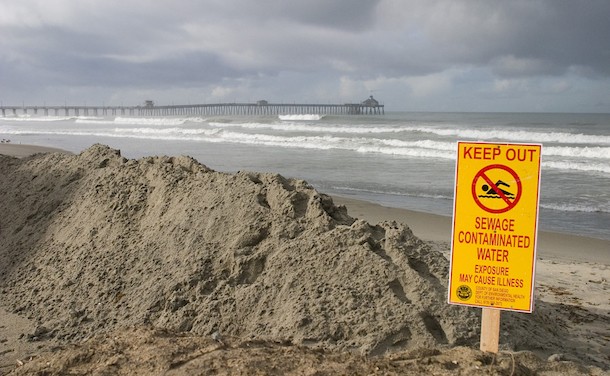
Commission staff provided a detailed update on the transboundary pollution crisis, which has severely impacted the health, livelihoods, and quality of life for residents of Imperial Beach and surrounding South Bay San Diego communities. Imperial Beach recently suffered 1,000 consecutive days of beach closures. Meanwhile, elevated hydrogen sulfide levels from aerosolized sewage pollution have created a public health emergency for both coastal and upstream communities, leading the County government to distribute indoor air purifiers to residents of Imperial Beach and surrounding communities. Coastal tourism and the businesses that rely on it are suffering as well. Several Commissioners expressed dismay at seeing such a beautiful beach town, its beaches empty and main street deserted.
Federal Consistency staff offered several suggestions for how the Commission might help. After noting an informational gap in water quality and ecological impacts compared to public health and economic impacts, the Commission’s Senior Environmental Water Quality and Environmental Scientists teamed up to produce the following document: Tijuana River Pollution Crisis: Literature Review on Water Quality and Ecological Impacts.
Additionally, Commission staff offered to convene quarterly interjurisdictional meetings with the various local governments, state, and federal agencies operating within the impacted areas to assist in streamlining projects and clearing bureaucratic hurdles that slow down local and state action to combat the pollution.
Due to being an informational update only, no vote was taken on this item. However, Commissioners expressed support for staff’s efforts as well as heartfelt concern for the suffering of the surrounding communities. The Commission heard an hour of public comment from local residents, advocates, business owners, as well as students from nearby Coronado High School.
Informational Update on the Sea Lions at La Jolla Cove
Commission staff provided an overview of the tenuous situation at La Jolla Cove, where sea lion colonies have claimed several formerly accessible beach areas and are constantly harassed by tourists despite signage, park rangers, and Sierra Club Seal Society’s volunteer docents. La Jolla residents remain divided over the situation, some supporting better protections for the marine mammals while others decry the loss of beach access, negative impacts to water quality, and a pervasive stench. Many called for better enforcement by the City’s rangers to keep people away from the sea lions, however the City questions their authority to enforce the Marine Mammal Protection Act while the responsible agency, NOAA, lacks resources to actively engage in La Jolla. San Diego’s Parks Director detailed the City’s ongoing efforts to minimize conflicts. However, park rangers do not step foot on the beach itself. This leaves the Seal Society’s volunteer docents with the impossible task of being the only frontline defenders of the sea lions, who sometimes abandon their helpless pups if human harassment continues unabated.
An informational update only, no action was taken on this item.
South Coast Deputy Director’s Report for Orange County
Nestled within the Deputy Director’s Report, yet another Emergency CDP (ECDP) allowing the Orange County Transportation Authority (OCTA) to place boulders on the beach in front of Cyprus Shores, San Clemente. This marks the fourth ECDP in five years without any formal followup CDP on the horizon. Meanwhile, OCTA has placed over 26,000 tons of boulders on the beach in this area, effectively destroying a 1,000-foot stretch of shoreline that provided lateral access between San Clemente State Beach and the world-famous Trestles surf breaks at San Onofre State Beach. Surfrider detailed their ongoing concerns in a comment letter - eliciting a formal response from OCTA - and in public comment.
A representative from Save Our Beaches - San Clemente also commented, correctly referring to OCTA’s reliance on riprap boulders as creating a “doom loop” for San Clemente’s beaches. The revetment is so large that sand cannot accrete on the beach, instead worsening beach erosion from wave refraction. This in turn causes waves to crash on top of the revetment instead further out on the beach, putting the railroad tracks closer to harm’s way and necessitating more and more boulders. Surfrider, Save Our Beaches San Clemente, and many others in the community are calling for sand and nature-based adaptation strategies in the short-term to preserve a sandy beach which ultimately provides the best protection for the railroad. You can learn more about Surfrider’s position statement here.
Oneka “Iceberg” Wave-Powered Desalination Buoy Pilot Project in Fort Bragg
The Commission approved a 12-month experiment to test a wave-powered desalination buoy in Fort Bragg. The pilot project aims to determine whether Oneka’s desal buoys can serve as a viable water source for Fort Bragg and potentially other coastal communities that suffer water shortages, without negatively impacting coastal ecosystems. While the ActCoastal coalition did not advocate for or against this pilot project, it’s notable given our previous opposition to large-scale desalination plants due to their negative coastal impacts, high energy reliance, and costs to ratepayers. In addition to the Staff Report, more info on the project can be found at the Mendocino Voice and the Noyo Ocean Collective website.