Meeting Overview
The Coastal Commission convened in Scotts Valley last week to tackle the most packed and consequential agenda of the year.
At Thursday's main event, the Commission delivered a resounding victory to the California coast with a unanimous objection to the first offshore fracking project ever proposed off our state. Coastal advocates rallied behind staff's recommendation to object to DCOR's proposal for deep sea fracking off its aging platform in the Santa Barbara Channel. Other than DCOR's representative, not one person spoke in support. No surprise, given the threat another oil spill would pose to our marine ecosystems, fisheries, beaches, and thriving coastal recreation economy.
The objection comes as the Trump Administration tries to strip the agency's authority to weigh in on projects in federal waters, like this one, that affect our coast. It's a powerful reminder of how the Commission stands up for our coast. Most Californians oppose offshore drilling, and the Commission gives them a voice in federal decision-making. Clearly a Pro-Coast vote.
The Commission also returned to the City of Pacifica's short-term rental LCP amendment, unexpectedly postponed back in February. After a long and contentious hearing, Commissioners approved a modified STR policy in a split vote. It now goes back to the City.
Further south in Monterey County, the Commission unanimously approved a condominium hotel on an industrially degraded stretch of beach in Sand City. Staff negotiated a strong public benefits package and strict anti-armoring conditions, making this a Pro-Coast vote. ActCoastal would prefer not to see development over sand dunes. Still, this is a compelling example of how Commission involvement makes an unavoidable project better than it otherwise would have been.
In Stinson Beach, the Commission concurred with the National Park Service's proposal to use nature-based adaptations to shield beach parking lots that are routinely inundated by winter storms. The project should reduce future damage and closures. The tradeoff is a 10% reduction in parking spots, a loss this small community will feel when summer crowds peak. But nature-based adaptation avoids hard armoring, which would compromise the very stretch of beach the parking lot serves. A solid Pro-Coast vote.
On Friday, the Commission earned a final Pro-Coast vote by approving staff’s modifications to San Diego's plan to restore 262 acres of wetlands in the northeastern corner of Mission Bay. Commission staff strengthened the City's already ambitious plan, which balances wetland restoration with retention of recreational amenities including a coastal campground. The LCP amendment marks a significant win for the City and the ReWild Mission Bay coalition, led by the San Diego Bird Alliance (formerly Audubon) and comprised of more than 100 local environmental and civic groups.
Read on for our full analysis of key votes, plus additional August meeting highlights.
Issues voted on at this meeting:
The Commission approved the City of San Diego's De Anza Natural amendment to the Mission Bay Park Master Plan with more than thirty suggested modifications. The amendment sets aside 262 acres of the northeast corner of Mission Bay for wetland and upland restoration.
The Commission certified the National Park Service’s proposal to repair and modify the public parking lots at Stinson Beach to improve its climate resilience using an impressive suite of nature-based adaptations. Working with the Commission, National Parks' prioritized managed retreat and nature-based restoration over hard armoring that would ultimately degrade the very beach these parking lots exists to serve.
The Commission voted unanimously to approve a 100-unit condominium hotel on a beachfront dune site in Sand City. While ActCoastal does not support putting a resort on sand dunes, we also recognize that staff assembled about as protective a package as the circumstance and constraints at this site allow. Secured conditions include retreat, restoration, a completed Coastal Trail, permanent dune protection, and a hard no on future armoring.
In a resounding victory for the California coast, the Commission unanimously objected to the first offshore fracking project in federal waters it has ever considered. Staff found the project would increase both the likelihood and the severity of a spill in the Santa Barbara Channel, an area that includes a National Marine Sanctuary, a National Park, more than a dozen marine protected areas, critical habitat for endangered whales, and some of the most productive fishing grounds in the state. The California coast is a resource of extraordinary and immeasurable value to the people who live here and visit, as well as to marine life and the entire food chain. Oil spills threaten ALL OF IT.
Other Discussions
Executive Director's Report
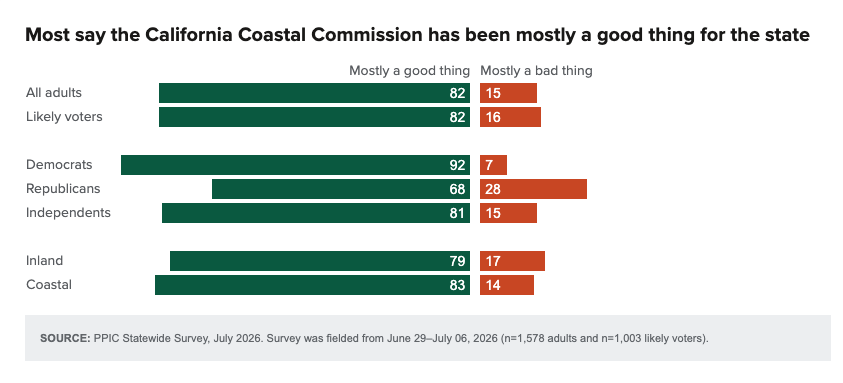
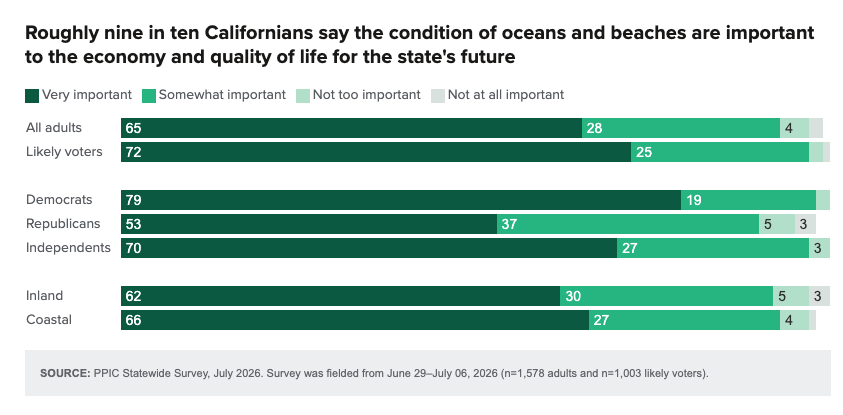
Executive Director Huckelbridge reported on the previous Monday's NOAA hearing in Santa Monica, where she and hundreds of other coastal advocates testified in defense of the Commission's record reviewing federal projects under the Coastal Zone Management Act. California's coastal management program is under unprecedented review by the Trump Administration, and risks decertification to pave the way for more offshore oil drilling in federal waters off our coast. She highlighted the Commission's 50-year record of success, citing a recent poll that found 82 percent of Californians believe the Coastal Commission has been good for California.
This month's public access spotlight focused on Monterey's famous Cannery Row, a stretch of coast made publicly accessible over time through six separate coastal development permits.
Pacifica STR
In what Chair Harmon called a "messy" hearing, the Commissioners further modified an already-modified staff recommendation for the City of Pacifica's LCP amendment covering short-term rentals in the coastal zone. They eliminated the City's primary residency requirement for unhosted rentals and doubled the annual cap on them from 60 to 120 days. The item was postponed in February after an overwhelming amount of correspondence, including some pointed legal threats from an AirBNB-affiliated lawyer. That month's staff recommendation would have approved the City's STR policy as submitted.
It now goes back to the City, whose elected leaders may or may not accept the Commissioners' modifications on top of the changes made by Commission staff. Judging from the City Manager's reaction, things may continue to be "messy."
Coastal zone STR policies have become a lightning rod in coastal communities and at the Commission, which reviews and ultimately approves the local government LCP amendments that govern them. The Commission has an established methodology for quantifying and requiring low-cost overnight accommodations. Nothing of the sort exists for STRs. Staff are left interpreting local STR policies through LCPs written long before AirBNB and similar STR platforms existed, weighing the coastal access opportunities STRs provide against the harm their proliferation causes in communities whose limited housing stock can be hollowed out by corporate STR companies. Staff describe the task as finding a balance that works for a community and its visitors while staying compliant with the Coastal Act and the LCP. The Commissioners themselves appear split ideologically, with some supporting STRs as maximizing coastal access and others more sympathetic to local residents' concerns about noise, affordability, and community character.
More specifics can be found in this article from Coastside News.
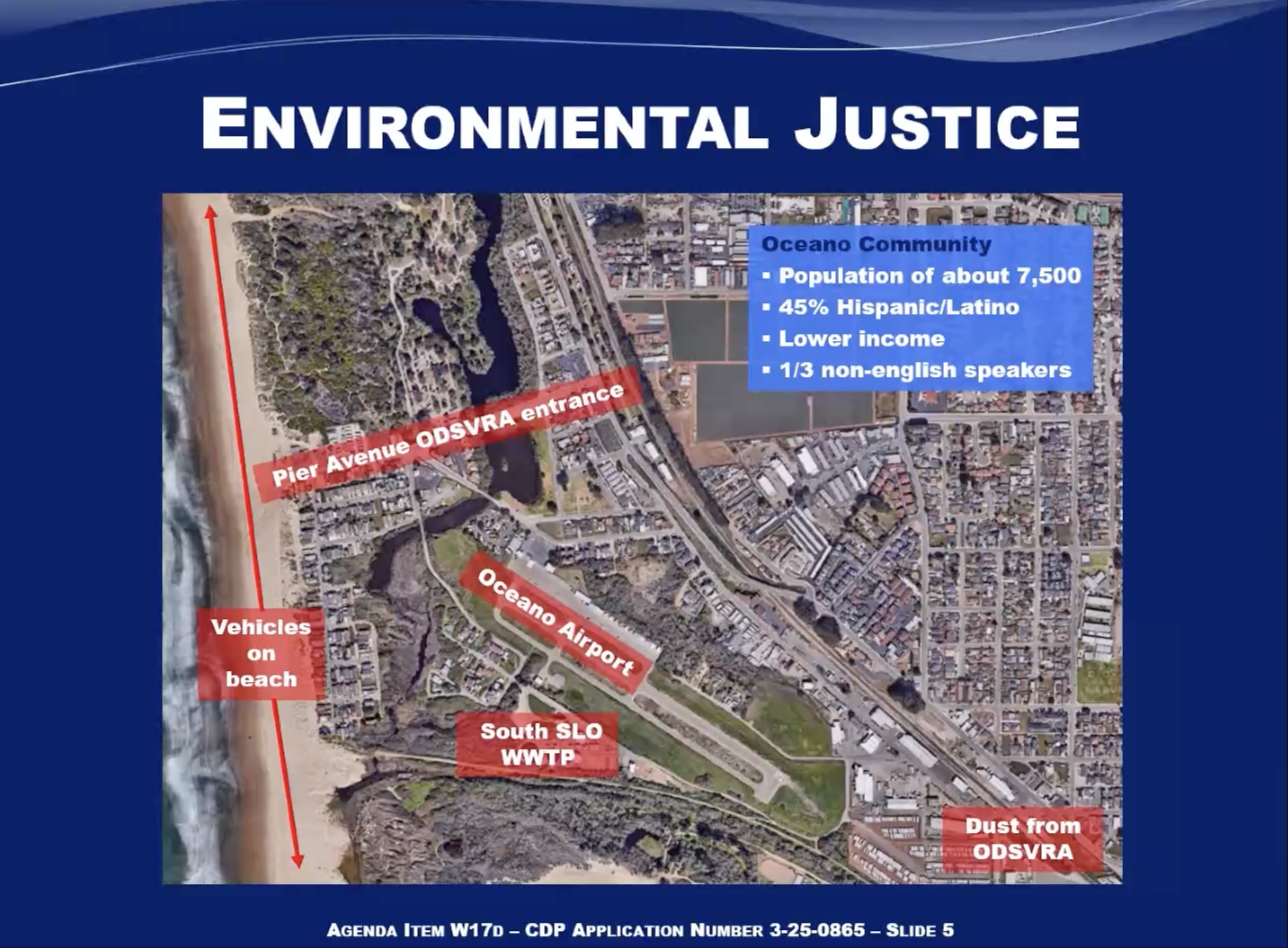
Environmental Justice Considerations for Oceano Airport
Commissioners unanimously approved staff's recommendation for repairs and upgrades at the Oceano County Airport, along with after-the-fact approval for ten episodes of unpermitted work going back to 1979.
The airport sits on an estuary that was filled in the 1950s. Filled tidelands remain in the Commission's jurisdiction, which is why San Luis Obispo County needed a permit.
Most importantly, staff found the airport has been rebuilt enough over the decades that it no longer counts as an existing structure, so it cannot armor. Instead the County has to monitor flood risk, set triggers, and analyze what it would cost to move or consolidate airport operations. Expansion and intensification are barred outright.
Staff's environmental justice analysis is worth a read. Oceano is a lower-income community flanked by a wastewater plant, a recreational airport, and a beach overrun by off-road vehicle traffic. Thanks to the Commission, the County will be required to include the Oceano community in future airport planning, offering them a seat at the table they haven’t had before.